18 August 2006

TV3 Ecomove Video online now!


Dear all,
We were on TV! Last Saturday we featured in A Ritme de Pedal (to the rhythm of the pedal) with our Ecomove we did in June. To see the video click here.
Thank you again to the team of A Ritme de Pedal and all our beautiful friends why came to help!

15 August 2006

Finally Without Woodlice

Once the wood had been sandblasted to clean of any varnish or paint, we started the treatment against the woodlice. The most common methods are:
Anti-return valves
It’s one of the oldest and most effective methods to treat installed woodworks. The valves are introduced into a series of holes previously drilled into the beams. With the help of a pump, the insecticide is injected through pressure into the beams. (Garbi S.L.)
The advantage of this method is that you don’t have to strip the beams of any paint but on the other hand the method is quite aggressive and labour-intensive. The holes that need to be drilled into the wood have an approximate diameter of 1 cm and have to be closed up with wax for example, at the end.
Impregnation
This method consists in spraying the whole surface of the wood that needs to be treated. Normally, using special spraying equipment, liquids or gels can be applied. (Garbi S.L.)
The controlled spraying with pressure of a low-toxic insecticide permits a quick and very efficient job in case of well-cleaned wood.

In our case we opted for the impregnation method with a new-generation low-toxic insecticide gel. The company Garbi offered us this treatment with a 10 year guarantee that no woodlice will return. They applied the gel to the wood with a pump capable of spreading the insecticide evenly, which at first leaves a visible layer of a few millimetres but which gradually gets completely absorbed by the wood. This method has a very localised application system without creating toxic fumes but let’s you back into your flat after a few hours. No need for quarantine here.

04 August 2006

Cleaning the Beams for the Woodlice with Sand

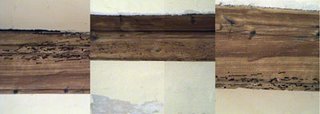
A strong advice we can give you is to check any wooden structures in your flat for woodlice, termites or other plagues. In Barcelona's Gothic quarter it is not uncommon to have at least one of them eating your flat and we haven’t been speared! The little holes in the wooden beams have been diagnosed to be the work of woodlice. So we won’t waste any time in treating the wood as the beasts keep feasting and there won’t be much of a Finca left in a few years.
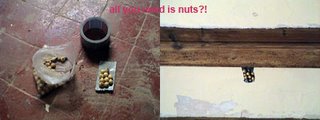
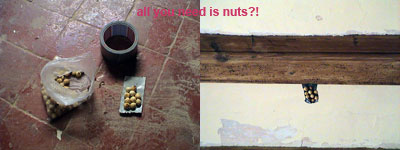
We read somewhere that the most eco-friendly way to get rid of them is to hang chestnuts (or was it hazelnuts?) in a net from the beams. For the woodlice it’s a delicacy so once they are all enjoying the nuts instead of your beams you just throw them out with the nuts. For all eco-friendly we are trying to be this sounds a bit like the tale of the Rat Catcher from Hamelin by the Brothers Grimm so we looked into more conventional methods to save our wood.
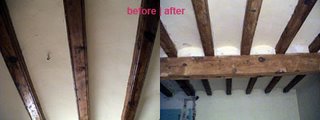
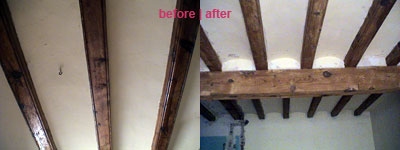
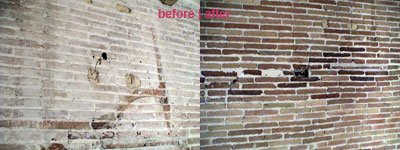
In order to treat the wood against woodlice we have to strip the wood of varnish and paint (or you'd have to drill holes into the wood in order to inject the product). Stripping can be done with heat (quite a long, difficult & expensive process depending on how many layers of paint you are trying to get rid of), chemical products (obviously not the most eco-friendly way) or sand blasting.
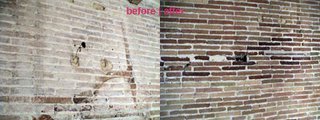
We opted for the latter since it doesn’t involve any chemicals and turned out to be fairly economical as well (€12/meter). We did it with the company Sorrejats Huracá who did a great job and cleaned the 130 meters of beam plus the brick wall in one day. More about the remaining woodlice and wood treatment in the next article.