Showing posts with label solar. Show all posts

27 January 2010

R3project round-up 7: the Balcony


Although we don’t have much of it, living in the Centre of Barcelona, we love our outdoor space. Our apartment has 3 small Barcelona-style balconies, that just about fir some flowerpots, a compost bin and a washing line.

No matter how little space you have, you can always grow some of your own herbs and spices, and even vegetables on windowsills, balconies or terraces if you don’t have a garden. We really like the Leopoldo Urban Vegetable Garden for it’s slick and practical design. Used indoors and outdoors, with wheels and available in different sizes, the Leopoldo is the perfect alternative to your standard ceramic pots and fits even into small spaces. We have managed to grow anything from parsley to basil, cherry tomatoes and cucumbers, chillies and strawberries.

One of the most important features of the R3project is the Can-O-Worms compost bin. We can’t get over the fact that thousands of worms on our balcony turn all our organic scraps from the kitchen and our plants into nutritious compost that we then use as fertiliser for the plants.

We had this worm composter for over a year and half now, and had had no bad surprises. Worms and homeowners are happy. And you would be surprised how much organic waste we recycle, since we ordered the organic vegetable box by Recapte. Every 3 to 4 months we get to collect some 8 kilos of fresh compost. Read here about how to install a Can-O-Worms (with video) and here about our first compost harvest.

Quite common in Barcelona, although not so in the United States where in some places they have even been banned, drying lines are the most eco-friendly way to dry your clothes. No energy is needed, no machinery, and the clothes end up smelling fresh.

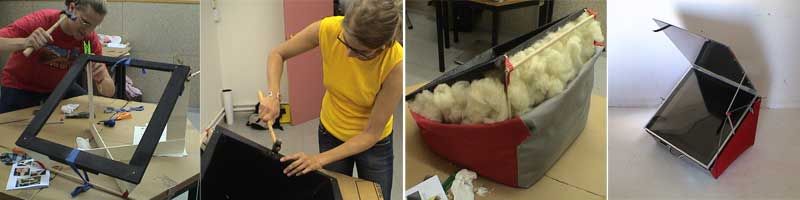
Then, on sunny days, we take out our solar oven we made in a workshop by Fundació Terra, and cook some delicious biscuits or hot bananas with melted chocolate…

09 January 2010

R3project round-up 5: the Office


The next room in our tour around the R3project is the studio, or office. Here we were able to restore the original floor tiles as they were in a much better shape as those in the rest of the flat, where we put down a cork floor and locally produced tiles. The proudest piece of furniture in the studio is no doubt the Steelcase Think chair, a masterpiece of Cradle to Cradle design, fully recyclable and very comfortable. We constructed the desk from a big piece of plastic and trestles we salvaged from the trash after a trade fair. The built-in cupboard is made from chipboard and has a wooden Venetian blind to close it. The ceiling lamp is a variation of our Bidon Lamp, made from a used jerry can. To not loose the overview, we use strips of natural cork to pin whatever projects we are working on.

Of the smaller gadgets we like the Voltaic solar bag which we use to charge our mobile phones and other small electronic objects. Of course we only use 100% recycled paper in our printer, and go to Cartridge World to have the cartridges refilled instead of buying new ones. This saves us money and waste. The stapless stapler is also a cool thing that every eco-conscious office should have. It staples sheets of paper together without staplers; watch a video of how it works here. This eliminates the metal staples that don’t do well in the paper recycling process.

For more ideas, check out the Planet Green Guide "How to be Green at Work".

Also check out the R3project round-ups for kitchen, bedroom, living room and general installations around the apartment.

14 December 2007

A Condensing Boiler for Hot Water


After a lot of research into different methods for obtaining domestic hot water, suitable for our home, we decided on a condensing gas boiler. In Barcelona, where we don’t have access to an alternative energy source (yet?), we concluded gas would be the most efficient way to heat the water for our shower, kitchen and central heating. The condensing boilers are especially environmentally friendly because of their efficient use of the gas and their considerably lower CO2 (responsible for global warming) and Nox (responsible for acid rain) emissions. We needed a combi-boiler in order for it to provide hot water for central heating as well as domestic hot water all year round.

In the wall-mounted boiler Cerasmart by the German brand Junkers, widely available in Spain, we found what we were looking for. The advantages: gas saving and low emissions.

How does it work?


The condensing boilers recycle the energy that is normally lost through the duct into the atmosphere. It catches the water vapour produced by the burning of gas for it to condense back into water. This way the heat, produced as water vapour, is recovered and the boiler uses less gas. Image by Junkers

“Typical condensing boiler efficiencies are around 90%, which brings most brands of condensing gas boiler in to the highest categories for energy efficiency. Condensing boiler manufacturers claim that up to 98% thermal efficiency of fuel conversion can be achieved in normal domestic use, compared to 70%-80% with a conventional design." (Via Wikipedia) Junkers claim the boiler Cerasmart to be 21% more efficient than standard ones, due to the fact that it can work at lower temperatures.

Condensing boilers are especially recommended if you have under-floor heating, low H2O radiators (like us) or other energy saving heating solutions.

A slight drawback is that you need to install an extra draining pipe to get rid of the condensate. This can either be installed vertically through the roof, or diagonally through the wall to the outside. (see photo on the right)

Another disadvantage might be the fact that condensing boilers are generally more expensive than conventional ones. It is estimated that “as of 2006, at UK prices the extra cost of installing a condensing boiler should be recovered in around 2-3 years” (via Wikipedia).

The Cerasmart boiler, for a 4-people flat with central heating by Junkers will cost you around 2268€ in Barcelona (you might be able to get a standard one for under 1800€). We bought ours at Tuysa.

Why we didn’t go solar.

Solar Hot Water Panels
would have been the most eco-efficient solution, but all the companies we contacted turned us off the idea. Technically, so they say after visiting our flat and roof, it would be very difficult due to the distance (2 floors) the water would have to travel to and from the roof. Plus we would have to give up 2 of our precious 58 m2 to make space for a not so beautiful water tank.

The initial first cost didn’t help make our decision easier as it would have been at the very least 2000€ for the panels to which we would have to add the installation cost and a back-up boiler. Moreover, we would have to get the approval of the fellow property owners of our building to install the solar panels on the communal roof. This shows again that eco-renovating a flat within the city is a very different story to building an eco house in the countryside where space and neighbours are less of an issue.

12 June 2006

SOUL Solar Oven available for the Rull3 Community


SOUL = Sun | Oven | Ultra | Light
Last weekend we took part in the Foundation Terra’s SOUL solar oven workshop and built a solar oven which will live in our flat but is available for everyone in the building to borrow and cook delicious meals with the sun on the communal and very sunny terrace. The idea is to bring friends together and make time to cook and eat together whilst using alternative energy. For more information on the SOUL solar oven visit TreeHugger or the maker’s web site directly: Cuisine Solaire (in French only). Many thanks to Pierre-Jacques for helping building the solar oven and to the Terra Foundation for their collaboration once again.