Showing posts with label tiles. Show all posts

20 January 2010

R3project round-up 6: the Bathroom


As you can guess, in the bathroom it is most of all about water, and using as less as possible of it. Our showerhead and the tap of the sink have low-flow faucet aerators that mix the water with air. That way less water is used but you still get the effect of a full shower. The aerators are easy to install, and only cost around 3€, while saving up to 50% water! We believe it’s a must for all taps.

Toilets are also using quite a lot of water. We find it easiest to reduce the water consumption at this end by regulating manually how much water we need each time to flush. Our Stop Flush system by Roca, let’s you decide how much water you need each time; the first flush starts letting water down the toilet bowl and the second flush stops it. If you happen to forget or your guests don’t know this system, it simply stops after a full flush of 12 litres. Read about other options for water-saving flushing devices here.

The next things to keep in mind are the materials you use in the bathroom. Because of the contact with water and a higher humidity level in the air, natural materials are not always recommended for bathrooms. We decided to use the same locally produced tiles as in the kitchen, only in red instead of white and green. The walls around the bathtub and the sink are covered with recycled plastic slate tiles, also a Spanish product. You can read about this experiment here and here.

The bathtub was actually in the apartment when we started the renovation, and despite a few scratched that could easily be fixed, it was in perfect shape. It was however not easy to convince the workmen to use this old tub instead of buying a brand new one, even if they are cheap. Bathtubs and sinks create a lot of waste when they are thrown out, often only because of a change in fashion, and not becasue they are broken. That is why we decided to get the sink Kalahari by Roca, a locally produced sink, made of much less material than most other designs.

We are also avoiding the use of PVC, so the alternative to a shower curtain was a simple glass sheet: long lasting and easily recyclable. Mirrors are not especially eco-friendly objects, so the best thing you can do is get a second hand one. Last but not least, we keep our bathroom clean with some eco-cleaning action. Click here for some recipes for eco-friendly cleaning products you can make your self- and that work!

If you want to know more about the R3project, you can read the round-ups of kitchen, living-room, office, bedroom and general installations.

12 October 2009

R3project round-up 2: the Kitchen


Our kitchen is an open one, and forms part of the living room, because we like to cook with our friends around.

KITCHEN FLOOR
The kitchen area is defined by a change of flooring. The cork floor of the rest of the apartment gives way to funky green and white tiles. We tried hard to find some local tiles made from recycled TV screens, but because the company went bust, we decided on some local colourful tiles by TAU Ceramics, whose effort towards sustainability we appreciate.

FURNITURE & STORAGE
The kitchen cupboards are made from recycled wooden wine boxes, carefully assembled by our amazing carpenter Rodrigo Diaz. The countertop is solid FSC-certified, untreated wood from IKEA. The same goes for the central piece of furniture called FÖRHÖJA that serves as storage and extra work surface. As a storage solution for the upper parts, we chose GRUNDTAL, fully recyclable stainless steel shelves from which you can also hang things like pots and pans. We prefer this system to cupboards for both aesthetic and practical reason, plus they are made from a minimum amount of materials.

WATER USAGE
As far as saving water is concerned, we installed a very special low-flow tab by Tehsa. We are still trying to fit in a dishwasher, as “the dishwasher uses only half the energy, one-sixth of the water, and less soap, to boot”, according to one study at the University of Bonn in Germany. However, as you can read in 'dishwasher versus hand washing' on TreeHugger, the situation is not as black and white. We are also looking for a water filter to drink the currently not very nice tasting water from the tab and stop buying plastic bottles. This has turned out to be a difficult mission, any tips are appreciated!

ELECTRICITY USAGE
We also try to use as less energy as possible. CFL lights illuminate our kitchen, and all the necessary electric appliances such as the fridge, oven and cooking surface, are A+ energy efficient.

THE FOOD
Of course you can’t have a kitchen without the food. Our fresh produce comes in a box every 2 weeks: 10 kg of locally grown, non-chemically treated vegetables and fruit from Recapte. All leftovers are fed to the worms in our compost bin on the balcony. To serve ourselves meals, we use fully recyclable glass plates.

CLEANING PRODUCTS
Last but not least, we like to clean green. Most of our eco cleaning products are mixed together in the kitchen, or at least stored under the sink.

More:
R3project round-up 1: General Installations at Home
R3project round-up 2: the Kitchen

25 January 2007

Recycled Plastic Slate in the Bathroom

We got them to stick, the slate imitating tiles made from recycled plastic.

This has been quite an experiment we’ve done with these imitations of slate that so far have only been used to cover roofs, but not in interior design. (Read previous article here)
We are proud to announce a second use for this high quality eco product. Quite a few people send us tips on how to attach them to the wall and Fabian, our Master worker at the flat, tried different ways to attach them to the bathroom walls, around the sink and bathtub. The third one worked but turned out not to be very eco-friendly. We had to use a silicon glue to make sure the tiles resist the water and humidity. Hopefully someone finds an eco-friendlier glue but we know they are rare. Despite this we are very pleased with the end result. The tiles are firmly stuck to the walls and look stunning. More than one visitor have been surprised to hear they were not real slate but made from recycled plastic.

A big thank you to the company Zicla, who donated the slate to us so we could try it out.

10 December 2006

Choosing Tiles

At this point we’d like to point out that yes! it is more difficult to do your flat up in green. The main problem is finding the right material with no lesser quality or higher cost and the same availability. Our hunt for the right tiles is a good example.
Over a month ago we were delighted with a sample of light grey, nearly white high-quality tiles made from recycled TV screens, which the company Zicla found for us. The price was also right (€10/m2) and so we ordered 8m2 for the kitchen area and the bathroom floor. When they finally arrived, shock horror! they were skin coloured, not white and not very sexy! Zicla called up the company to find out what happened. They told us that this is now the only colour they do, it’s the ‘natural’ colour and can vary from grey to ‘pink’?! Rather upset that we couldn’t have our recycled TV screens on the floor we started looking for different tiles. As one by one the tile shops turned us down when asking for eco tiles, then sadder we got that the company with the recycled tiles stopped producing the only pretty design they had in their catalogue.
GresCatalan however seemed to have some eco-friendly ones on offer. Being a local product with their factory only 80km from Barcelona definitely reduces the environmental impact related to transporting such a heavy product. So when shopping for heavy materials; shop locally. Grescatalan had a few funkier, 100% natural versions of ceramic tiles with reddish tones that we liked (even though we were hoping for a non-rustic choice…) but unfortunately they didn’t fit our budget, costing €68/m2.
While pondering the tile shops some really nice bright coloured tiles caught our eye by the well-known Spanish brand TAU Ceramics. When we got home we looked into TAU ceramics and were pleasantly surprised when we found a whole page about sustainability on their web site. TAU ceramics are based in Castellón and make tiles from raw materials using a firing process. Their factory coexists side by side the biggest lake and waterpark of the industrial centre in Castellón. TAU are currently developing eco materials, have set up a water purification system as well as managed to minimize the use of water during the production process by reusing the water. They also have a strong waste management, have reduced their emissions into the air and the noise pollution. All this obtained them the ISO 14.001, well explained on their web site.
Ok, they might not be made from the most eco friendly material but they are highly durable. Most importantly for us, the company seems to make a difference by applying tougher eco criteria to their production and is still very competitive in the market, offering a wide range of designs. And the latter is as important as being environmentally friendly because if the economics don’t work, there’s no point having an eco product that doesn’t sell. We went for juice apple green and white tiles in the kitchen and bright red for the bathroom, both from the collection Collage. Here in Barcelona, Dani Casado (Tel: 935751359) amongst others sells the full range of TAU Ceramics.

05 September 2006

How to apply Zicla’s recycled plastic slate to our bathroom?

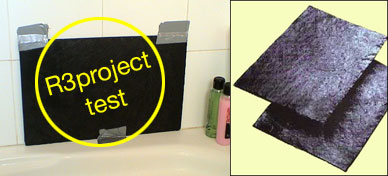
The company Zicla (recycled materials for construction) have sponsored us with these fantastic imitations of slate made from 89% recycled industrial waste rubber. It looks very much like traditional slate, is more lightweight, doesn’t break easily, can be cut no problem, is totally waterproof, highly durable and insulating against the cold and the heat. The size: 280 x 240 x 4 mm. Those properties make it perfect to build roofs or to cover façades. We would like to give it a third use however and use it indoors instead of tiles in the bathroom around the shower and sink area. We tested a sample out in the bathroom and the water drops don’t even leave ugly marks on them. So our question to you is:
How would you attach this slate to the wall and have it waterproof?
Please fill in your idea as a comment so we can easily share ideas with all of you. Thanks!