Showing posts with label heating. Show all posts

29 September 2009

R3project round-up 1: General Installations Around the House.


The R3project is almost complete; the renovation of the apartment is finished and we are living in it with our worms on the balcony, recycling and saving on energy and water wherever we can, without loosing comfort or style. In the following months we will finish this blog with a few round-up posts to give a better overview of the sustainable design solutions we applied to our apartment. This article is about the general installations around the house. The next ones will include the kitchen, living room, bedroom, bathroom, office and balcony. We hope you enjoy it.

MOVING HOUSE
The general stuff around the house are mostly things you cannot see any more, but that play an important role when it comes to sustainable living. We started the R3project off with an eco-move, where we brought our stuff into the new apartment without emitting CO2. How? With a bicycle and a little help from our friends, watch the video here.

GETTING AN ETHICAL MORTGAGE
The month before the move, we were shopping for mortgages, and managed to get a loan with the ethical banc Triodos Bank. They guarantee that they only give money to ecological, social or ethical projects. We like that!

RECYCLING DEBRIS
Next we had to get rid of a few sacks of debris, and found out that Sacos Marones recycle the debris. It’s a great service widely available in Spain.

WATER INSTALLATION
In order to avoid PVC in our home, we had to look harder to find recyclable plastic pipes for the grey water installation. In the end we used the tubing system by AquaTherm, which is easy to install with ordinary tools, and, copper pipes for the fresh water and heating installation. The Jaga radiators we chose are ‘low H2O’, which means they also need less energy to run (because there is less water to heat). To heat our water we use a condensation gas boiler. What we really recommend, even without undergoing a full renovation, are low-flow faucet aerator. They cost around 3€ and save you up to 50% water. Depending on what flushing system your toilet has, you can also save a lot of water. We opted for a ‘Stop Flush system’.

ELECTRIC INSTALLATION
Just like for the water pipes, we managed to find PVC-free plastic tubes for the electricity. We used recyclable corrugated polypropylene tubes that are also organochloride and halogen free. Connected to the end of those are of course CLF lightbulbs and A-efficient electric appliances. We even managed to find eco-friendly plugs made form recyclable plastic, and light switches, made in Spain from certified wood.

PAINTS AND WOOD FINISHES
Our walls are painted with zero-VOC paint, and the wooden beams and balcony doors are treated with ecological and natural oils.

INSULATION
In order to keep heating costs down and keep the apartment cool without installing air conditioning, we made sure the place is completely insulated. Double-glazing was a must, and the cork floor an extra bonus to both thermally and acoustically insulate the apartment.

More:
R3project round-up 1: General Installations at Home
R3project round-up 2: the Kitchen

14 January 2008

Jaga Low-H20 Radiators to Heat Our Home


Just on time for the colder months we had central heating installed. To take advantage of our condensing boiler and to save as much as possible when turning on the heat, we went for the Low-H2O radiators by the Belgian company Jaga, called Energy Savers.

Low-H2O stands for low water, meaning that the radiators contain less water than traditional ones. They function on average with only 2 instead of 20 litres. If you run your central heating system like us on a condensing gas boiler, we don’t recommend traditional radiators (as you would not be able to save much energy despite the efficient boiler) but endorse Low-H20 ones or radiant floor heating. The latter was not an option for us due to the weight that would have had to be added to the floor and could have caused structural problems to the over 100 year old building.

The Low-H20 system brings with it the advantage of warm radiators immediately. A newly developed heat exchanger made from aluminium and copper (instead of heavy steel plates that take longer to warm up) lets the heat immediately into the room. Another advantage is the cost savings. A scientific study by Jaga has shown that Low-H20 radiators consume at least 12% less. This is because less water needs to be heated up and the radiators react sooner to the heat; both when starting and stopping the heat. Jaga also claims that ‘homes with Low-H20 radiators annually emit as much as 1000 kg less CO2, and Low-H20 is therefore much less polluting for the environment”. For those of you with kids, there’s no need to worry about burned fingers anymore; the Low-H20 heaters release the heat evenly and therefore don’t need to be super hot. This also results in a greater comfort for everyone at home.

Something that surprised us was the way the radiators arrived at our house. They came flat-packed with one of the radiators measuring 10 x 60 x 120cm in a 10 x 10 x 120cm box for example. A bit worried at first, we realised that the assembly was very straight forward and quick. From an eco point of view we love flat-pack: it reduces the transport and packaging impact drastically. We would also like to mention that Jaga produces in Spain, which is perfect for us in terms of keeping the transportation impact as low as possible.


To give you an idea about pricing, the wall-mounted model 'Strada' measuring 10 x 60 (height) x 100cm (wide) costs 170€. It is suitable for rooms of around 12 m2. In total, our 5 radiators with their installation pieces cost us 1500€ IVA included, and their full installation 1360€. For those of you who have a bit more money to spend than us, check out the Knockonwood series with gorgeous FSC-certified wooden panels as decoration for the radiators. More about those on TreeHugger.

Last but not least, it’s not just the type of heating system that saves you money and is kinder towards the environment, but also the way it is used. Insulating your home (more on double glazing here) or simply putting on another sweater is all part of wise heating. “Each degree Celsius less will save about 10% on your energy use”, says TreeHugger. For more tips, check out How to Green Your Heating.

27 May 2006

to heat or not to heat and how to heat

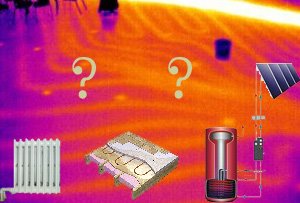
Not many second hand flats in Barcelona have central heating so instead people use very energy intensive electric heaters or bottled gas heaters (not without danger). We thought since we have to do the whole flat up we might as well use the opportunity to put in a radiant floor.
Why? –Because underfloor heating is supposed to be the most comfortable and eco-efficient form of heating. This is because it heats up the rooms evenly from the bottom to the top (since heat rises) instead of localised heating through radiators that need to produce a lot of heat in order to keep the other side of the room hot too. Plus no heat is lost through ducts. It’s also healthier they say, since it doesn’t dry out the air as much and heats up your feet and hands first (warm hands and feet, cool head). Another big advantage is that it is totally silent and non-obtrusive. It saves you a lot of space and you won’t have to worry about the aesthetics of any radiators. Eco-friendly material is also available such as a cork base (local and fast renewable) and PVC-free tubes (hence recyclable) to conduct the hot water.
Now this all sounds great but after a reality and wallet check it doesn’t seem too efficient anymore since the cost of installing a radiant floor is not worth what you save on energy and in our case it demands some massive construction work. The only possible exception is a water heating system (other types are air-heated and electric radiant floors) used in conjunction with solar heating.
Now we are in Spain so solar heating sounds obvious, doesn’t it? Think again! First you need permission to decorate the roof of the building (which normally is communal and used for sunbathing and laundry drying) with the solar installation (and some people don’t like the look of those). Second, the solar heater needs somewhere to store the hot water and where do you put a big black 2m high and ø1m water deposit in a 55m2 flat?
An alternative to solar heating is one of those new efficient gas heaters that heat the water for the floor and for the rest of the house. But that still leaves us with the actual radiant floor installation whose cork base and water tubes are normally covered with concrete. Now that is a hell of a lot of added weight for an old building like ours which means the old floor would need to go. And that means 2 weeks of picking the floor (and screaming neighbours) as well as getting rid of the rubble by carrying it 3 floors down (! no lift in that part of antic Barcelona). We’d also have to check with an engineer if we can take out the old floor (who knows what’s underneath) and if it’s structurally safe to add a radiant floor to this old building.
Conclusion: So after having a clearer picture of what it would mean to install a radiant floor (money, risks, side effects, time, …) we started wondering if it’s worth it. After all we are in Barcelona where you’d use heating at most 4 months a year. The advantage would obviously be the fact that the rest of the year you don’t have to sit amongst use-less radiators but don’t they do small sexy ones nowadays? And if you operate them with that energy efficient gas heater (that reuses the heat of the gas flame to heat the water, …) until you convince the rest of the flat owners to invest into communal solar heaters? You could still make the whole thing PVC free, insulate the flat properly so no heat is wasted and have a timer on it for more efficient use. We’re still investigating on this but if you have any suggestions please let us know!
More information on radiant floors: EERE (US), Klaus (Spain), Self Build ABC (UK)