Hi! You reached the R3project web site, a blog about how to adapt urban housing to a green lifestyle. It is the diary of an ecological renovation of an old apartment in the heart of Barcelona, and a guide to a more responsible way of living.
This blog had been growing with our flat, ripening with the experience and evolving with the participation of our readers. Between 2006 and 2010 we published our step by step eco-renovation. The work is now finished, and so is the blog but we hope you can still get inspired by the result and find useful information for your home.
Feel free to scroll through the 5 Rs of ecodesign or visit each room by reading the round-ups in the left sidebar. We also appreciate any comments and hope you share your knowledge and thoughts about eco-friendly urban living.
For current projects by eco designer Petz Scholtus, please visit Pöko Design.
Showing posts with label about us. Show all posts
Showing posts with label about us. Show all posts
17 May 2011


23 February 2010
Open R3project - Oct 29 2010
 As part of the Barcelona Design Week, we are participating in the Design Circuit, and opening the R3project (which houses the Pöko Design Studio) to show and sell eco-friendly products and interior design. Together with Matteria (good design + smart materials) and Evohé organic wine, we would like to show you around, so come and visit us on october 22nd, between 16h-20h.
Flyer designed by Ernest Vidal.
27 January 2010
R3project round-up 7: the Balcony

Although we don’t have much of it, living in the Centre of Barcelona, we love our outdoor space. Our apartment has 3 small Barcelona-style balconies, that just about fir some flowerpots, a compost bin and a washing line.
No matter how little space you have, you can always grow some of your own herbs and spices, and even vegetables on windowsills, balconies or terraces if you don’t have a garden. We really like the Leopoldo Urban Vegetable Garden for it’s slick and practical design. Used indoors and outdoors, with wheels and available in different sizes, the Leopoldo is the perfect alternative to your standard ceramic pots and fits even into small spaces. We have managed to grow anything from parsley to basil, cherry tomatoes and cucumbers, chillies and strawberries.
One of the most important features of the R3project is the Can-O-Worms compost bin. We can’t get over the fact that thousands of worms on our balcony turn all our organic scraps from the kitchen and our plants into nutritious compost that we then use as fertiliser for the plants.
We had this worm composter for over a year and half now, and had had no bad surprises. Worms and homeowners are happy. And you would be surprised how much organic waste we recycle, since we ordered the organic vegetable box by Recapte. Every 3 to 4 months we get to collect some 8 kilos of fresh compost. Read here about how to install a Can-O-Worms (with video) and here about our first compost harvest.
Quite common in Barcelona, although not so in the United States where in some places they have even been banned, drying lines are the most eco-friendly way to dry your clothes. No energy is needed, no machinery, and the clothes end up smelling fresh.
Then, on sunny days, we take out our solar oven we made in a workshop by Fundació Terra, and cook some delicious biscuits or hot bananas with melted chocolate…
20 January 2010
R3project round-up 6: the Bathroom

As you can guess, in the bathroom it is most of all about water, and using as less as possible of it. Our showerhead and the tap of the sink have low-flow faucet aerators that mix the water with air. That way less water is used but you still get the effect of a full shower. The aerators are easy to install, and only cost around 3€, while saving up to 50% water! We believe it’s a must for all taps.
Toilets are also using quite a lot of water. We find it easiest to reduce the water consumption at this end by regulating manually how much water we need each time to flush. Our Stop Flush system by Roca, let’s you decide how much water you need each time; the first flush starts letting water down the toilet bowl and the second flush stops it. If you happen to forget or your guests don’t know this system, it simply stops after a full flush of 12 litres. Read about other options for water-saving flushing devices here.
The next things to keep in mind are the materials you use in the bathroom. Because of the contact with water and a higher humidity level in the air, natural materials are not always recommended for bathrooms. We decided to use the same locally produced tiles as in the kitchen, only in red instead of white and green. The walls around the bathtub and the sink are covered with recycled plastic slate tiles, also a Spanish product. You can read about this experiment here and here.
The bathtub was actually in the apartment when we started the renovation, and despite a few scratched that could easily be fixed, it was in perfect shape. It was however not easy to convince the workmen to use this old tub instead of buying a brand new one, even if they are cheap. Bathtubs and sinks create a lot of waste when they are thrown out, often only because of a change in fashion, and not becasue they are broken. That is why we decided to get the sink Kalahari by Roca, a locally produced sink, made of much less material than most other designs.
We are also avoiding the use of PVC, so the alternative to a shower curtain was a simple glass sheet: long lasting and easily recyclable. Mirrors are not especially eco-friendly objects, so the best thing you can do is get a second hand one. Last but not least, we keep our bathroom clean with some eco-cleaning action. Click here for some recipes for eco-friendly cleaning products you can make your self- and that work!
If you want to know more about the R3project, you can read the round-ups of kitchen, living-room, office, bedroom and general installations.
09 January 2010
R3project round-up 5: the Office

The next room in our tour around the R3project is the studio, or office. Here we were able to restore the original floor tiles as they were in a much better shape as those in the rest of the flat, where we put down a cork floor and locally produced tiles. The proudest piece of furniture in the studio is no doubt the Steelcase Think chair, a masterpiece of Cradle to Cradle design, fully recyclable and very comfortable. We constructed the desk from a big piece of plastic and trestles we salvaged from the trash after a trade fair. The built-in cupboard is made from chipboard and has a wooden Venetian blind to close it. The ceiling lamp is a variation of our Bidon Lamp, made from a used jerry can. To not loose the overview, we use strips of natural cork to pin whatever projects we are working on.
Of the smaller gadgets we like the Voltaic solar bag which we use to charge our mobile phones and other small electronic objects. Of course we only use 100% recycled paper in our printer, and go to Cartridge World to have the cartridges refilled instead of buying new ones. This saves us money and waste. The stapless stapler is also a cool thing that every eco-conscious office should have. It staples sheets of paper together without staplers; watch a video of how it works here. This eliminates the metal staples that don’t do well in the paper recycling process.
For more ideas, check out the Planet Green Guide "How to be Green at Work".
Also check out the R3project round-ups for kitchen, bedroom, living room and general installations around the apartment.
23 December 2008
A new look and Happy 2009 from the R3project
We have changed our look just in time to enter 2009, and we hope you like it. Thank you for being with us throughout 2008, we would like to wish you a Happy New Year. May it be a good one for people, planet and profit!
(If you like the Happy 2009 video, please send it on to your friends.)
29 July 2008
The Canary Project Visited Barcelona
It was a pleasure to meet Ed and Susannah here in Barcelona a few weeks ago. They are the founders of the Canary Project, a US-born organisation that creates a better public understanding of climate change and motivates solutions towards the same by producing visual media, events, and artwork.
Canary has nothing to do with the islands but rather with the birds that were used to warn miners of deadly methane levels. The Canary Project works similar: it warns us of the severe changes to come by for example photographing changing landscapes. Another of their projects is the Green Patriot Poster campaign, that motivates individuals to act against climate change, with posters inspired buy the imagery of World War II.
Read here what the Canary Project has to say about the R3project, and watch the video to get another glimpse into our eco-flat Lab.
Thank you Susannah and Ed, it was nice meeting you. Come back soon.
30 June 2008
R3project video report by Tendenciastv
Tendenciastv visited us last week. Have a look at the video (in Spanish) to see what the R3project really feels like. Thank you Francesca for a great report!
27 December 2007
Our Thoughts for the New Year

Thank you to all our readers for sticking with us through 2007. It was definitely an exciting year for us as we finally got to move into the eco-flat lab, as Epi called it. Although a bit slow in posting articles at times, we were able to share some more green achievements with you.
We installed recycled plastic slate in the bathroom, appeared on TV with Silenci?, put down a gorgeous cork floor, reduced our water consumption and installed double glazing, applied real eco paint, hunted down some furniture, started urban gardening and built FSC shelves. All this while eco design became more and more mainstream, big businesses decided to go green(er) and people’s climate change awareness grew drastically not least because of An Inconvenient Truth, Live Earth and Al Gore and the UN's Intergovernmental Panel on Climate Change winning the Nobel Price.
We hope that in 2008 this awareness grows in order to eliminate green-washing and even plastic bags, and make us all more responsible consumers, and that more and more people achieve the win-win-win (for people, planet, profits) scenario by making their business sustainable. On a more local scale, the R3project will look into the most eco-friendly heating system, water filtering systems, cradle to cradle office chairs, analyse our electricity, gas and water bills, find out where our recycling goes and hopefully, throw a huge Open House Party for everyone who has been involved with the project.
A Happy New Year to all of You,
Petz & Sergio
11 May 2007
Happy Birthday to Us
 There’s reason to celebrate as today 1 year ago, we started the R3project Blog on May 11th 2006.
 It started with an ethical mortgage, an eco move and since then we have finished the renovation, we have moved in and now we are busy with the interiors, furniture, composting and spring gardening on the balcony. More soon…
Thank you for following our project with such a big enthusiasm and all the nice comments we received throughout the past year. We hope we can keep inspiring you and we are looking forward to your feedback.
Best wishes to all of you!
Petz & Sergio
27 May 2006
the Layout
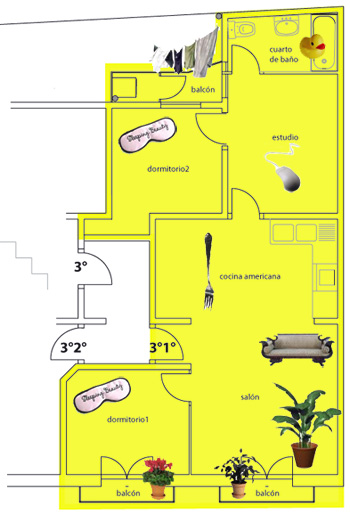 So you can start to imagine it too:
• open kitchen & living room
• 1 bathroom
• 2 bedrooms
• 1 studio
• 3 balconies of which one is half used for storage & the washing machine
The Renovation that needs to be done
 Apart from beautiful beams and French windows in need for restoration the flat doesn't have much to offer yet. So this gives us enough freedom to choose and put the most efficient installations from scratch. The most important eco aspect however is to reuse whatever we can. This means for example restoring the woodwork (windows, doors,...) and the floor as well as keeping the bath tub which is in perfect condition. Unfortunately the plaster walls need to be removed to optimise the space. What else needs doing in general:
• remove & put dividing walls
• fix humidity from soil pipe along the outside wall
• replace the toilet on the balcony (!) with a washing machine
• the bathroom
• the kitchen
• painting
• furniture & products for domestic use
• city garden
• ...
21 Tips for a Sustainable Home towards Agenda 21
This is a list of what you can do to make your home more sustainable. We will step by step develop these further and look for the best solutions for our flat.
 Sustainable Living on an Every Day Basis
1. water consumption
2. energy consumption
3. improve comfort
4. better use of domestic equipment
5. recycling
Sustainable Through Maintenance
6. maintenance of the installations
7. maintenance of the facade
8. maintenance of the roof
9. maintenance of the railings and locks
10. maintenance of balconies and windows
Sustainable Shopping for Your Home
11. electro domestics
12. heating and air conditioning
13. furniture
14. new or second hand eco housing
15. products for the home
Sustainable Renovation
16. construction material
17. thermo and acoustic insulation
18. reuse water
19. renewable energy
20. correct management of construction waste
Last But Not Least
21. Make it all happen!
[via Ajuntament de Barcelona & Collegi d’Aparellarors i Arquitectes Tècnics de Barcelona]
For more information (in Spanish) : Agenda de la Construcción Sostenible
 Sustainable Living on an Every Day Basis
1. water consumption
2. energy consumption
3. improve comfort
4. better use of domestic equipment
5. recycling
Sustainable Through Maintenance
6. maintenance of the installations
7. maintenance of the facade
8. maintenance of the roof
9. maintenance of the railings and locks
10. maintenance of balconies and windows
Sustainable Shopping for Your Home
11. electro domestics
12. heating and air conditioning
13. furniture
14. new or second hand eco housing
15. products for the home
Sustainable Renovation
16. construction material
17. thermo and acoustic insulation
18. reuse water
19. renewable energy
20. correct management of construction waste
Last But Not Least
21. Make it all happen!
[via Ajuntament de Barcelona & Collegi d’Aparellarors i Arquitectes Tècnics de Barcelona]
For more information (in Spanish) : Agenda de la Construcción Sostenible
The 5 Rs of Eco Design
You may have come across Reuse Reduce Recycle as the key principles towards a Restorative Economy to do ‘less bad’ and most of all ‘more good’.
In May this year however, a discussion on o2-Global about how many Rs an eco design product / service / packaging / man-made thing should cover resulted in 5 Rs. This means that if a design can incorporate Reuse Reduce Recycle Recover and Respect it pretty much deserves a green label. You might argue that there are many more Rs to add but to keep things simple and manageable, o2UMW has outlines them as the following which will guide us towards an eco flat (renovation & living it). R3project examples in orange.
Run all finances through an ethical bank, go carbon neutral, use sustainable materials (such as FSC wood), …
Support the local economy (shop local, local crafts, …), respect the environment (aesthetic, neighbours, local plants for the garden, … ), …
Reduce the use of energy & water (alternative sources, smart wiring & plumbing, energy-efficient light bulbs and white goods, efficient use of energy & water, …), noise (insulation,…), CO2 (by compensating and cycling), food miles (by shopping locally), …
Materials in the flat (bathtub, doors, windows, …), grey water, restore second hand furniture, use plastic containers in the kitchen instead of cling film, …
Use recyclable materials (PVC free water pipes, …) and recycle (comfortable facilities to recycle glass, plastics, paper and organic waste on a day to day bases).
[via o2-Global]
In May this year however, a discussion on o2-Global about how many Rs an eco design product / service / packaging / man-made thing should cover resulted in 5 Rs. This means that if a design can incorporate Reuse Reduce Recycle Recover and Respect it pretty much deserves a green label. You might argue that there are many more Rs to add but to keep things simple and manageable, o2UMW has outlines them as the following which will guide us towards an eco flat (renovation & living it). R3project examples in orange.
Innovation Checklist: The 5Rs of Great Design
RESTORE
Use materials (and support firms) that help reverse damage or -- add -- to natural capital.
Run all finances through an ethical bank, go carbon neutral, use sustainable materials (such as FSC wood), …
RESPECT
Examine impacts the item will have on stakeholders, as well as eco-systems -- social plus environmental justice, look for the win-win-win scenario (triple bottom line).
Support the local economy (shop local, local crafts, …), respect the environment (aesthetic, neighbours, local plants for the garden, … ), …
REDUCE
Reduce the materials needed to do function, including: less materials used, less weight to transport (reduce fuel demands), less energy to manufacture, less energy to store (aseptic pack vs. refrigerated milk), less energy to use (compact fluorescent bulbs vs. incandescent), reduced toxicity (reduce to ZERO).
Reduce the use of energy & water (alternative sources, smart wiring & plumbing, energy-efficient light bulbs and white goods, efficient use of energy & water, …), noise (insulation,…), CO2 (by compensating and cycling), food miles (by shopping locally), …
REUSE
Reuse something already manufactured, and make item easy to BE reused with minimal remanufacturing (Like wine barrels that get turned into taiko drums when they retired from wine making).
Materials in the flat (bathtub, doors, windows, …), grey water, restore second hand furniture, use plastic containers in the kitchen instead of cling film, …
RECOVER
Create item to be fed BACK into the resource loop (includes Cradle to Cradle), have a robust and easy to use system to RECOVER materials, and USE RECYCLED substrates to make the item (100% PCW paperboard) wherever possible. Under this clause we would naturally tuck the old favourite -- RECYCLE the things you recovered.
From: o2UMW
Use recyclable materials (PVC free water pipes, …) and recycle (comfortable facilities to recycle glass, plastics, paper and organic waste on a day to day bases).
[via o2-Global]
Buying the Flat, Getting a Mortgage & Starting to Go Eco
 We found this flat in November last year and since then it has been quite a fight against the money sharks of the Spanish property market! Prices are high and still rising and the owners are normally estate agencies rather than private owners with a lot more experience than most people in the art of rip-off.
So it happened that the owners of this flat tried to sell it to me with a big fat structural wall right through the middle of it which meant no access to half of the flat without some major building work! I had to get my Spanish man to talk to them as 'pretty blonde female' didn'’t seem to be taken seriously when she said she'’s not going to buy it without a doorway. And oh what a surprise! it worked and this week they are putting the door into the dividing wall. Something to bear in mind when buying a flat is that it'’s easy to follow what others tell you rather than to stop and think. In my case the owner of the flat had a very good connection with a bank. So without thinking twice I went there and they gave me an attractive deal. It was so easy and I felt kind of obligated that I didn'’t even think of who I was going to give my money to. Three months later though this bank realised that the flat doesn'’t have the license (called cédula’ in Spanish) you need by law to live in a flat. I mean how could it have those papers if there isn'’t even a bathroom or kitchen in the flat?! Negotiating started all over again, we came to a new agreement but I wasn't very confident with the bank. Which is why (better late than never) I looked into ethical banking and found Triodos.
Meeting with Triodos in their brand new office was a whole different experience. They actually try to understand the whole project, were interested in who I am and what I do not just to make sure I can pay my bills but because they needed to know where the money goes. Their conditions might not be AS good as those an ordinary bank can offer you but at least you sleep well at night and it'’s certainly about more than Euribor.
All this meant quite a few months waiting with a headache but made time for dreaming up a flat. In the end everything happens for a reason they say and here the reason for me having to wait must have been clearly giving birth to the R3project. The idea was always to make my flat eco-friendly since I am an eco designer, grew up amongst vegetables and cows (thanks mum and dad) and have this passion for greening things. BUT I had my reservations: ‘uh, more expensive?... more time consuming?... can I really do it?'…I thought, well, I can install some solar panels later and use eco-friendly paint but will I research everything from what water tap is the most efficient and which heating system makes the most sense?
So this last month when things started looking more positively and we pretty much had assured the buying of the flat I got my act together and decided to go for a full eco-friendly renovation, and share my experiences with you. You can be as eco as you want but when it comes down to practicality it's often easier to go with the flow which right now is not green. I hope my research will help you though make your home more sustainable.
Only the Beginning
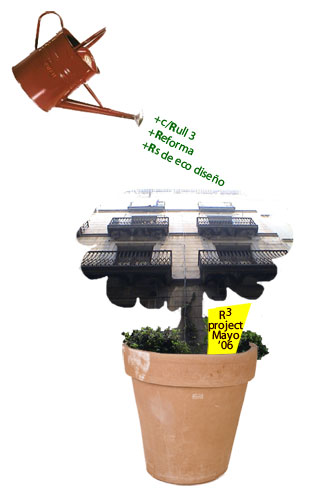 We found the flat, it's been registered with the government and evaluated so now we 'just' have to buy it! For that we need a mortgage, an ethical one please! Then we'll move our stuff in there, carbon neutrally of course- anyone up for cycling? And then it's shopping for eco building materials...
A quick Welcoming Note
 Hi & Welcome! This is a blog about how to renovate a flat (in Barcelona) in an eco-friendly way and how to live a greener urban lifestyle. Petz Scholtus and Sergio Carratalá Lamarca are the main bloggers but guest writers will be invited. The flat really exists so you can follow the research, analysis, final decisions and practicality of eco concepts and products available to renovate a flat and live in it in a sustainable way. The blog will create a dynamic diary / guide for everyone to participate by commenting (so please do!).
Enjoy the show!
Subscribe to:
Posts (Atom)
